For our online journalism class we had to recreate a news website in wiki form. Myself and Alan Regan recreated the Daily Telegraph's website.

Visit our
Telegraph homepage An example of an
article page

Is it simply the cost benefit to media producers that is making them take notice of citizen journalists? It would be cynical to suggest such a thing, but it's a suggestion not without some truth.

Local papers in America are beginning to encourage participatory journalism. One such paper is
Bluffton Today which is one of the most successful local papers in the States. Their whole model is based on merging citizen journalist produced content alongside the content of staff writers. The daily publication was originally a freesheet but began charging 25c and 75c on Sundays.
The paper and website are being heralded as the new model for local papers, at least in America. This is just one example of where traditional journalism is merging with its citizen cousin.

There's one large repercussion of online journalism on journalists themselves that hasn't really been disucessed in any great detail. Online news is becoming more and more about the individual reporter. They must maintain blogs and twitter updates and keep the website up to date with the latest news (which now has the most miniscule of turn around times). The stress on a person of maintaing all this is incredible.
But the main point I was to make is that, in a tradtional newsroom, it was very easy for a journalist to take holiday time and he/she would be covered by another staffer. This si not the case anymore, the highly demanding twitter followers and readers of their blogs will not wait for a journalist to rest for a week or two like they themselves would expect to be able to do. This new breed of news consumers are demanding and if a journalist neglects them, even for their own well-being, they will migrate.
I think too much is being expected of journalists today. Convergence is all well and good, but the benefit of convergence is that a journalist can report in the most appropriate medium, not report in all media, all the time. There will come a stage where media employers are just expecting far too much of their employees. A worker of any kind can only take so much, that time has not yet come, but it will!
Denis
Filed Under:
Labels:
Interactivity,
online editions
The Guardian and the Times are using Live Blogs to cover the events on the campaign trail. The blogs are nearly akin to micro blogging, though not as sparse in the length of updates as Twitter.
The blogs ensure that all the election news is neatly aggregated and easily accessible by visitors.
The
Guardian's blog is time stamped and has the party logos alongside the news when it relates to a specific party. There are also quote marks to the left if an indented quote to quickly identify them as such.
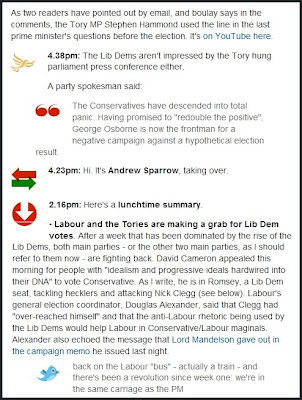
There is also an icon with arrows in an opposite direction to indicate that the author of the blog is changing. The blog links to other articles to allow readers read a more in depth article about the bigger stories. Web 2.0 is also included in the shape of tweets, which are clearly marked with the customary blue bird.
Denis
Filed Under:
Labels:
Interactivity,
online editions
The Irish Examiner is Ireland's third daily broadsheet newspaper. It status as a national paper is often questioned. The one platform that really levels all the papers is, or should be, the internet. The best way to attract visitors to the website is through having well written content which is neatly displayed and easily navigable.

A cursory look at the
site will show that there is a heavy showing for advertisements. The ads are not carefully placed either, they take prominence over everything else on the site.
One thing that the site does well, which may be a hangover from the print edition, is that the main story is the first thing that grabs your attention when the page loads.
After that the site lets itself down again and again. The headlines section for news only comes after two story teasers. The same format is followed for the world and sports news sections.
The worst thing about the website is that there is no real sense of cohesion to its layout.
The
article pages have no integration of web 2.0. There is a large picture at the top of the article which is followed by a large amount of text. The only thing that breaks the text up is a very crude Google ads advert. The only hyperlink actually asscoiated with the article is email and share buttons located at the top of the page.
All that aside, the worst thing about the site is that the content is only updated when the print edition goes to bed. The same stories are in the headlines for nearly 24 hours before they're changed.
 Bebo
Bebo was Ireland's first foray into the world of social networking on a truly global scale. The announcement by AOL that it's decided to cut its losses comes as no surprise though. The site has been haemorrhaging users in the last few years and never really secured a proper hold in the UK market.
Bebo will probably come to be seen as a development stage of social networking sites. One of the main reasons for its demise was probably the fact that it was not as instant as its main rival facebook. Disseminating news was laborious in that if you wanted to let you friends know something you either had to leave them a message on their page or message all friends. The latter option was usually seen as an annoyance to the receiver and is akin to the group messages recevied by most users on facebook now.
Bebo's framework was one of the first tries at social networking and facilitated that very well. Where Bebo failed was it did not see news dissemination becoming an important part social networking and even when it arrived Bebo failed to change accordingly.
The
Irish Times and the
Irish Examiner don't use hyperlinks in articles and the
Irish Independent links very rarely and only internally. Does this represent a failure on behalf of the newspaper industry to fully inform with their readership? Surely they should link to supplementary information which would give a more rounded understanding of the situation to visitors to their site.
I think the problem here is that the papers feel as if they are already providing too much content for little or no revenue online. This could be seen as extra work which they are not willing to do. It is also probably a contributory factor that the received wisdom is not to link to other websites for fear that your readers won't come back.
I'm not sure that not linking to other information is failing the readership. I think that it is incredibly easy to do a quick google search if the reader feels they need some extra information. I'm sure linking will become a bigger part of news website in general but I would be cautious as to just how much linking is included in each article.
It could
act as a
distraction from the
original story which would
defeat the
purpose.
Of course, the main difference is the fact that mobile journalists (mojos) are paid by the paper they write for. After that is taken out of the equation there are few differences. A mojo will probably be better equipped, but their output looks very similar to that of a citizen journalist.
Mojos report on everything and anything and record the event for all forms of broadcast and print. One of the main jobs of a mojo on a local paper is to train local people to be citizen journalists who will get paid to contribute to the newspaper.

I think the idea of being a mojo is a good one if it means that you are prepared to record an event in several different ways. However, if it means that you run around like a headless chicken trying desperately to cover everything, but nothing in detail, then it's a very bad idea.
Newspapers are struggling to find a viable business model for their online versions and it's not at all easy. But what benefit does the internet as a publishing platform provide?
The internet allows papers to display advertising on their pages which is tailored to each individual reader. The ads are chosen for each visitor to the site based on their search history. This means that visitors are more likely click on the advert and therefore earn more money for the paper.
This advertising can also be less invasive than all for one advertising which can cause annoyance for a large percentage of visitors.

The level to which an advert can be targeted is quite intriguing. If you click through to the larger version of the image above you'll see that there is an advert targeted at me through this very blog.
Press Ombudsman John Horgan talked about the legal difficulty of newspapers' online version vetting comments on articles. Addressing the DCU Journalism Society, he said he was aware that there are three full time journalists employed by the guardian to moderate reader comments. He also said that some comment threads just get too hot and are all wiped by the moderator. Talking about the legal repercussions, he said that comments must be very carefully moderated if they are to be included on newspaper websites.
Journalists are used because of their knowledge of media law and what constitutes defamation. This highlights another trend in that journalists are being asked to do something that isn't exactly the traditional definition of journalism.
The news that the BBC is telling its staff to embrace social networking sites in news gathering is the last sign that news sources are fundamentally changing. Peter Horrocks, director of Global news said: "If you don't like it, if you think that level of change or that different way of working isn't right for me, then go and do something else, because it's going to happen. You're not going to be able to stop it."
If the BBC are to use social networking to improve their news output they must not just throw caution to the wind, It must be embraced with a certain level of intelligence and sobriety, if not caution. The old journalistic values must still be held firm by newsrooms. Facts must still be checked and verified, sources must be reliable. Twitter and facebook are reliable, but they also pose dangers with regards to news gathering. It is incredibly easy for romours, hearsay and conjecture.
It is undeniable that social networking will become an invaluable news source for newsrooms the world over, but the profession must not throw caution to the wind when embracing this relatively new phenomenon.